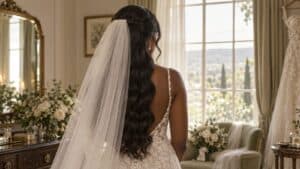
Wind will find the one loose curl your stylist placed beside your face. Humidity will take hair that behaves at home and double it. A beach wedding style has to look good after it moves, because it is going to move.

Sandals Will Throw Your Wedding for Free
Stay 7 nights in a Club or Butler suite and Sandals covers the wedding: a personal planner, the ceremony, a private cocktail reception, a two-tier cake, your bouquet and boutonniere, plus $200 toward photos and $200 toward video. No venue hunt, no vendor juggling.
The plan that works is not more hairspray. It is a secure shape, texture that is honest about your hair, a product sequence you tested outdoors, and a trial early enough to change your mind.
Resort brides: Sandals’ free wedding package covers the ceremony setup but not hair and makeup, so budget for those separately or book the on-site spa early. See the current Sandals offer or read our breakdown of the fine print.
Pick a style that can move a little
Immovable hair is not the goal. Helmet hair photographs badly and feels worse. What you want is strong support underneath and a surface that can lose a few strands to the wind without the whole thing coming apart.
Styles that hold up on an exposed beach:
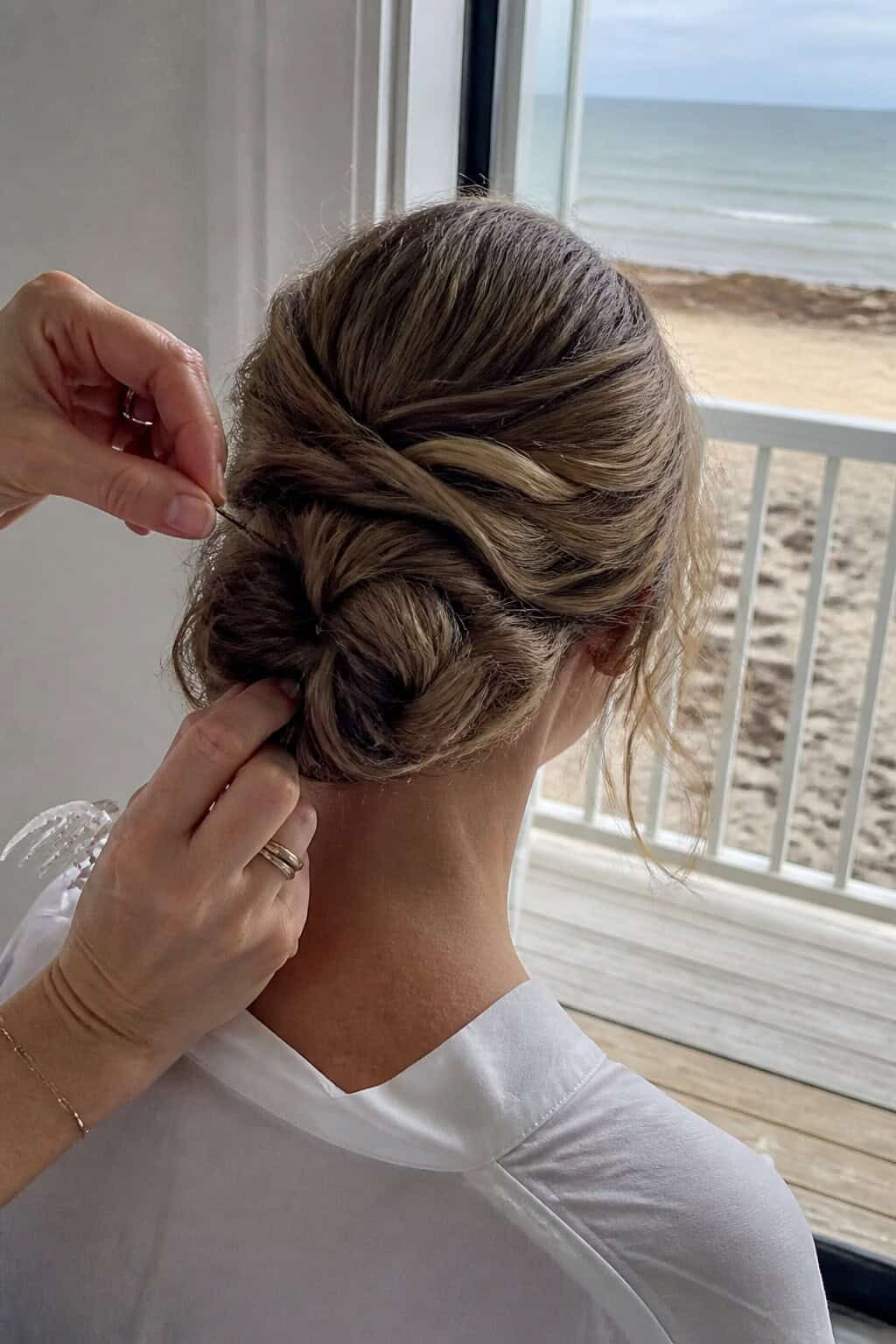
- Low textured bun (the safest beach style there is, and the most flattering with a veil)
- Braided chignon
- Sleek low ponytail
- Bubble or segmented ponytail
- Half-up with the top section properly anchored
- Defined natural curls pinned away from the face
- Braids gathered into a bun or ponytail
- Short hair shaped with controlled texture
Loose beachy waves are the style everyone pins and the one that fails most often. They work on a sheltered terrace or at a calm evening ceremony. On open sand at 4 p.m., they separate, drop, and blow across your mouth in every third photo. If that softer look matters to you, shoot portraits right after styling and have your stylist build in a pin-back option for later.
What humidity actually does to hair
Hair absorbs water from the air, and water resets the bonds a blow-dryer or flat iron temporarily rearranged. That is why straightened hair reverts and curls swell. Once the dew point gets above about 65°F, which is most Caribbean and Gulf afternoons, a style that fights your natural pattern is on borrowed time. At 70°F and above, it is a matter of minutes.
Two things help. The first is choosing a shape closer to what your hair wants to do. The second is a film-forming anti-humidity product applied before the style is built, not sprayed on top afterward. Color Wow Dream Coat (blow-dried in, on damp hair) is the one most stylists reach for on smooth styles. Living Proof No Frizz Humidity Shield and Oribe Impermeable both work as a final layer. For curls, a proper gel cast (Ouidad Advanced Climate Control gel is made for exactly this) will hold definition long after a mousse gives up.
What doesn’t help: three coats of hairspray. It gets tacky in humidity, catches sand, and turns fine hair into a stiff sheet that cracks when it moves.
What wind does, and where to stand
Anything over about 10 mph, which is a normal beach afternoon, will take face-framing pieces and hold them across your face. Over 15 mph, a long veil becomes a sail and a half-down style is a bad idea. Check the historical wind for your date and time on a weather site before the trial, not the week of.
A trick that costs nothing: ask the coordinator which way the wind usually blows at your ceremony time, and orient the ceremony so it hits your back or side. Sound and sun permitting, a 30-degree turn keeps hair and veil off your face for the whole thing. Plenty of coordinators do this by default. Ask anyway.
Sweat, sunscreen, and the hairline
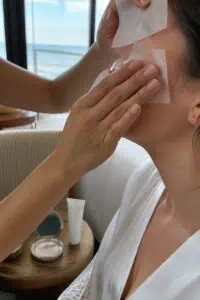
The hairline is where beach hair goes wrong first. Sunscreen migrates up from the forehead, sweat comes down from the scalp, and by the reception the first inch of hair looks wet and flat while the rest is fine.
Keep face sunscreen a finger’s width below the hairline and let it set before hair is finished. Blot with a tissue, never wipe. For the part and any exposed scalp, a powder SPF like Supergoop Poof (SPF 35, and it doubles as dry shampoo) or a scalp mist like Coola Scalp & Hair Mist SPF 30 protects without oiling the roots. Apply it before the style is finished, then leave it alone.
One photo warning: white dry shampoos and silica-based texture powders can flash pale under a camera flash, the same way some setting powders do on skin. Use a tinted dry shampoo or brush the product through completely, then check with a phone flash in a dim room. Your makeup artist will be doing that test for your face anyway; add your hairline to it.
Match the style to your hair, not the reference photo
A good inspiration photo shares your density, length, curl pattern, and cut. A style shown on thick hair with two packs of extensions will not behave the same on fine shoulder-length hair, and no stylist can make it.
Tell your stylist:
- How your hair reacts to humidity
- Whether curls normally hold, and for how long
- If your scalp gets oily quickly
- Where you sweat
- Whether you are open to extensions or padding
- How much tension you can tolerate
- What the wind is likely to do at the venue
Bring three or four references and say what you like about each one: the height, the part, the smoothness, the face framing. Then ask what gets you the same feeling with your hair. A stylist who says “not on your hair” at the trial is doing you a favor.
Updos: the engineering underneath
A low bun or chignon keeps hair off your neck, cuts tangling, sits under a veil comb naturally, and is easier to anchor than a high, heavy shape. A good beach bun uses 30 to 50 pins, mostly hidden, and should not hurt.
Fine hair needs something to grip: a bun donut, a little padding, or a few clip-in wefts. Thick hair needs the weight split into several anchored sections so one set of pins isn’t holding everything. A braided base under the bun gives pins something to bite, and nobody sees it.
Ask for pins in your hair color and for U-shaped pins in the bun itself, which hold volume without flattening it. Then turn your head all the way left and right before the stylist packs up. If you can’t, it’s too tight and will ache by the vows.
Ponytails and half-up styles
A sleek low ponytail is the underrated beach option: controlled front, movement in the back, and it takes two minutes to fix. Wrap the elastic with a pinned section of hair, reinforce the base, and keep the tail textured and straight rather than curled, since curls will drop in the humidity anyway. A bubble ponytail with small clear elastics every four inches looks deliberate even after wind has been at it.
Free Wedding Planning Checklist
Stay organized from engagement to "I do" — get our comprehensive checklist covering every task, deadline, and detail.
Keep the tail from rubbing against beading or a hook-and-eye closure on the gown. That friction frays both.
Half-up needs more structure than it looks like it has. The pinned section should anchor below the surface with hidden elastics, a small braid, or crossed pins, not two decorative clips. Leave fewer face-framing pieces than you would indoors, especially on the windward side. And pack a wide-tooth comb and a detangler like Ouai Leave In Conditioner for the end of the night; the lower hair will have knotted.
Curls and coils: work with the texture
Humidity pulls hair back toward its natural pattern. A straightened style on hair that curls strongly needs constant defense, while a well-defined version of your own texture just gets a bit bigger and still looks like the plan.
Use the wash-day routine that reliably gives you definition, and don’t experiment in the wedding week. A new deep conditioner or a heavy butter can change volume and hold in ways you won’t like on the day.
Ask the stylist how they’ll protect curl clumps while pinning or placing a veil. If they don’t regularly work with your texture, find someone who does, even if that means flying your own stylist in. This is the single most common complaint about resort salons, and it is worth solving before you land.
The trial timeline
Book the stylist 3 to 4 months out; the good ones at popular resorts fill up. Then:
- 6 to 8 weeks before: the trial. Use the exact product sequence planned for the day, wear it outside for at least four hours, and photograph it at the end, not in the chair. If you can do the trial on a hot, sticky day, do.
- Destination brides: a home trial with a local stylist is still worth the $75 to $150. Take detailed photos from the front, sides, and back and send them to the resort stylist with your product list. The alternative, a first meeting the morning of, is a gamble.
- 3 weeks before: color and cut, so it settles and any surprise can be fixed.
- 2 weeks before: last chance for anything new: keratin, smoothing, extensions, a different shampoo. After this, nothing changes.
- The night before: wash unless your stylist says otherwise. Day-old hair grips pins and holds a curl better than freshly washed.
- The morning: 60 to 90 minutes for the bride, 30 to 45 per bridesmaid, plus 20 minutes of buffer that will get used.
At the trial, look for frizz at the hairline, pins that slide, curls that drop, white residue, a tacky surface that catches sand, scalp pain, and product transferring onto fabric. Every one of those is a product or structure problem you can fix in six weeks and cannot fix in six minutes.
Decide on the veil by testing it outdoors
A veil gives you the movement everyone wants in beach photos, and it catches wind for the same reason. Longer is not automatically worse. A short single-layer veil can flip forward over and over, while a heavier embroidered edge tends to stay down. Fabric weight, comb placement, and wind direction matter more than length.
Bring the actual veil to the trial. Have the stylist place and remove it without disturbing the style, and have the person who’ll remove it after the ceremony practice once.
For an exposed beach, consider:
- A veil with a slightly weighted or embroidered edge
- A shorter single-layer veil
- A cape veil attached securely to the dress
- Wearing the veil only for the ceremony and immediate portraits
- A comb, pins, flowers, or headband instead
Don’t sew in metal weights yourself; they swing and tear tulle. Ask the veil maker. And use our beach wedding dress guide to think about veil, neckline, and gown fabric together.
Accessories go on top of the structure, not instead of it
Combs, pins, flowers, and headbands decorate a secure style. They don’t hold one together. Build the hair first, then add the piece.
Heavy combs need an anchor, usually a small hidden braid or crossed pins. Fresh flowers should be wired by the florist and chosen for heat; orchids and ranunculus last, gardenias brown by dinner. Wear any headpiece for a few hours at the trial and check the pressure behind the ears. A headache is not a reasonable price for a headpiece.
The morning: schedule and room
Work backward from the time you must be dressed for portraits or the shuttle. Your stylist should set the order for the group; the bride is not always last, and finishing right at departure leaves no time for pin adjustments, the veil, or the photo of your mom zipping the dress.
Get the stylist an air-conditioned room with a clear table, outlets, a real chair, a mirror, and window light. Keep the balcony door shut; every time it opens, the room’s humidity jumps. And keep the crowd down. Extra bodies add heat, drinks, and questions, and the stylist needs room to put a 400°F iron down safely.
Wear a robe or a button-front shirt so nothing passes over finished hair. Keep perfume, sunscreen, and breakfast away from the work surface. The beach wedding checklist connects beauty timing to transportation, tide, and setup.
A small rescue kit, handed to the right person
Ask your stylist to fill it, because more spray is rarely the answer. A sensible kit:
- Bobby pins and U-pins in your hair color
- Small clear or hair-colored elastics
- Travel-size of the hairspray used at the trial (Kenra 25 and Elnett are the two stylists tend to swear by)
- Edge-control or smoothing cream with a clean applicator
- Wide-tooth comb for textured hair, or a small brush for a sleek style
- Blotting papers for the hairline
- A satin scarf if the style needs covering in transit
Give it to one person who watched the style being built. Random pins pushed into a loose section make it worse.
Between the room and the ceremony
Use a closed, air-conditioned vehicle when there is one. An open golf cart or a ten-minute walk down the beach exposes finished hair before a single photo is taken. If you must travel outside, delay the final surface spray until you arrive, and while you wait at the site, stand with the wind at your back.
Let it look lived in
Beach hair does not need to look untouched at 9 p.m. It needs to keep its shape, stay out of your eyes, and still look like you after the weather joins the party.
Pick a shape with a real foundation. Test the whole product sequence outside. Bring the real veil to the trial. Then let a few strands go. The bride who spends the ceremony pinning her hair back is in every photo doing it.