Picture the ceremony from the back row. With 16 guests there is no back row. Everyone is close enough to hear the vows over the surf, assuming you did the one thing most couples skip, which is rent a microphone. That’s the whole appeal of a small beach wedding: nobody is far from anything. It’s also why the mistakes are so visible. There’s nowhere to hide a bad plan when the whole guest list fits at one table.

Sandals Will Throw Your Wedding for Free
Stay 7 nights in a Club or Butler suite and Sandals covers the wedding: a personal planner, the ceremony, a private cocktail reception, a two-tier cake, your bouquet and boutonniere, plus $200 toward photos and $200 toward video. No venue hunt, no vendor juggling.
The best small beach weddings aren’t big weddings squeezed into fewer chairs. They use the size. One long table. A 15-minute ceremony. A restaurant terrace instead of a tent. And, if you want the shortcut, a resort that does the whole thing for you: Sandals hosts the ceremony free with a qualifying stay, which deletes the venue search entirely. Here’s the current Sandals offer and our breakdown of the fine print before you get excited.
Plan around your least mobile guest
Before you fall for a cove you reached by climbing over rocks, think about the person who’ll have the hardest time getting there. Someone with a cane. Someone eight months pregnant. Someone with a toddler on a hip. Someone who needs a restroom within two minutes’ walk.
Ask the venue:
- How far is it from where the car stops to where the chairs are?
- Is that route paved, boardwalk, packed sand, or the soft stuff?
- Are there stairs? Is there a handrail?
- Do you have a beach wheelchair, and does it need to be reserved?
- Where’s the nearest restroom, honestly?
- Is there shade to wait in before the ceremony starts?
With 20 people you can use tiny sites that would never work for a normal wedding. That’s a gift. It’s not a gift if your grandfather has to watch from the parking lot.
Pick a venue that comes with plumbing
“Beach wedding” covers a public beach, a resort, a rented house, a beach club, a restaurant, or a hotel lawn 30 feet from the water. Each one hands you a different amount of work.
Public beach
Cheap and genuinely beautiful, and you control almost nothing. Swimmers, dogs, a guy with a Bluetooth speaker, the lifeguard truck. Usually no power, no storage, no restroom, no rain shelter.
Call whoever manages the beach, which is usually the city or county parks office. Florida beach towns charge somewhere between $25 and $250 for a ceremony permit and most ban stakes in the sand. Hawaii’s state beaches require a right-of-entry permit that a licensed officiant or planner holds on your behalf. Ask about chairs, arches, amplified sound, alcohol, candles, confetti, parking, and the time window, and get the answer in writing.
Resort or hotel
Chairs, staff, restrooms, power, a room to get ready in, and an indoor backup, all included. The price is a required stay, vendor restrictions, or a private-event fee. Ask whether the beach itself is private. In most places the shoreline is public even when the pool deck isn’t, so expect a few spectators in swimsuits in your wide shots.
Restaurant or beach club
For fewer than 20 guests, this is our favorite answer. A short ceremony on the sand, then a two-minute walk to a terrace that already has a roof, a kitchen, staff, lighting, and bathrooms. Most will do a private room or terrace for a minimum spend of $1,500 to $4,000 instead of a venue fee, which for 18 people is just dinner.
Our lists of beach wedding venues and affordable beach wedding venues are a place to start. Confirm current rules with the property, because they change and the internet doesn’t.
Get the permit anyway
Six people, an arch, and a photographer with a tripod is still an event in the eyes of most parks departments. The permit sets your spot, your time window, your footprint, and what you can bring. Some require proof of insurance or a cleanup plan. Some allow a standing ceremony but not chairs.
Don’t take “we do this all the time” from a planner unless the contract makes them responsible for pulling the permit. Confirm who applies, who pays, and when approval lands. Then keep a copy on your phone, because the ranger may ask.
Build the rain plan on the same day you book
“We’ll decide that morning” isn’t a plan. A plan is a second usable ceremony space you have seen.
Ask where the ceremony goes for rain, lightning, high wind, extreme heat, big surf, or wildfire smoke, and look at recent photos of that exact room. Count the chairs. Check the light and the air conditioning. Ask whether another event could bump you.
Then decide who makes the call and by what time. Moving 18 people is easier than moving 180, but the florist, the chairs, and the sound system still need an hour. If there’s no covered space, reserve one: a restaurant room or a villa veranda will do. A tent needs its own permit, anchoring, flooring, delivery access, and a decision days before the forecast is sure.
The beach wedding checklist goes deeper on wind, tide, heat, and keeping people comfortable.
Time it for light and heat, not for “sunset”
Sunset is a moment. Your ceremony is 15 to 25 minutes, and your photographer wants portraits before or after. If the sun sets at 7:10, a 5:45 start puts the ceremony in warm light and leaves 45 minutes of golden hour for photos. Start at 7:00 and half your ceremony is in the dark. Ask the photographer for a schedule built on the exact location, since a beach with hills or hotels to the west loses light earlier than the almanac says.
Free Wedding Planning Checklist
Stay organized from engagement to "I do" — get our comprehensive checklist covering every task, deadline, and detail.
Check the tide table for your date. In the U.S., NOAA’s Tides and Currents site has station-level predictions. A beach that’s 60 feet wide at low tide can be a strip at high tide, and a generic annual chart won’t tell you which one you’re getting at 5:45.
Water and shade even for a short ceremony. Sand burns bare feet. Metal chairs cook. A basket of paper fans is a nice gesture and not a shade plan.
Keep the setup small enough to survive wind
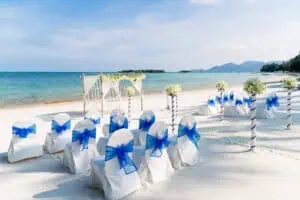
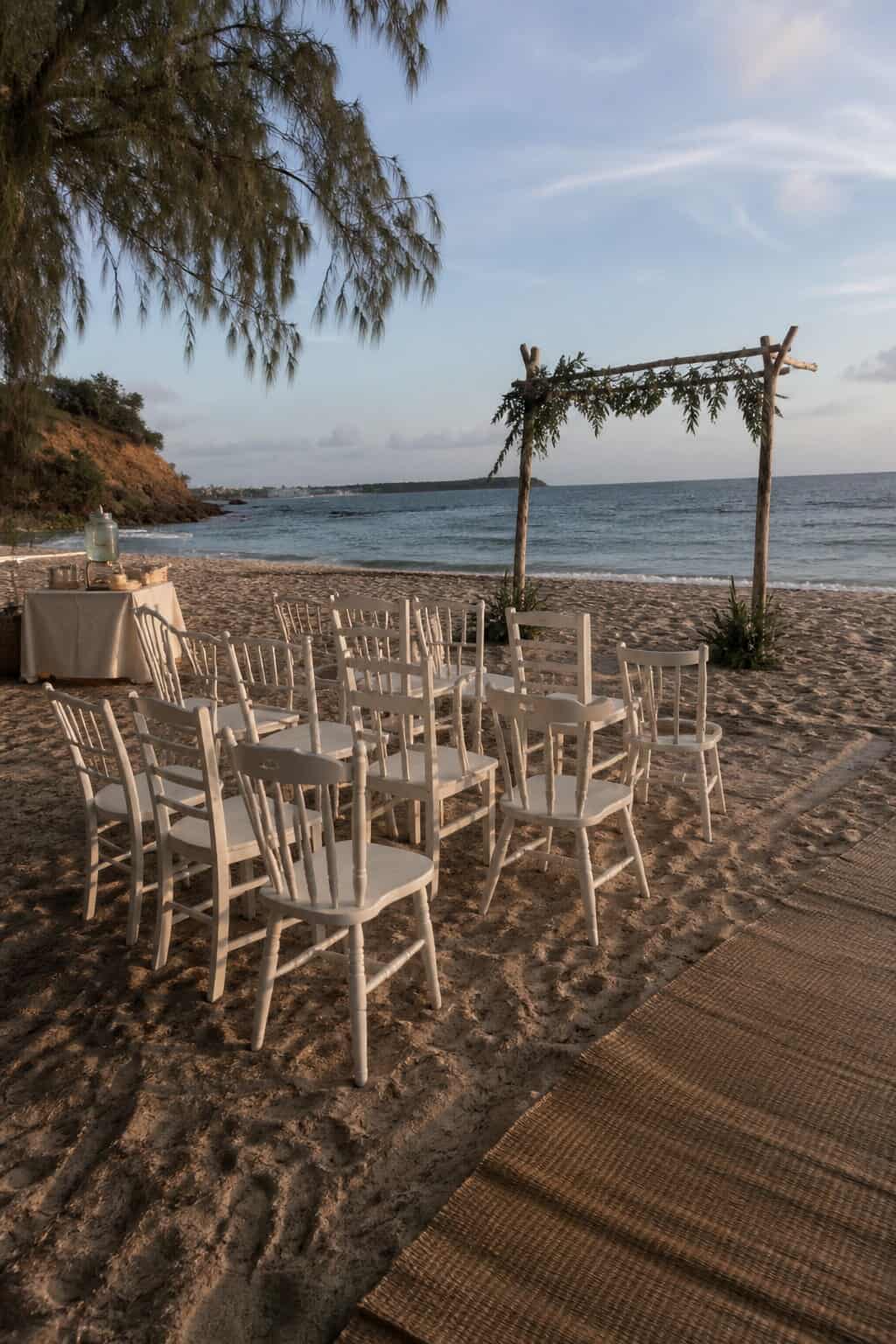
For under 20, two or three short rows are enough, and you may not want an aisle at all. A shallow semicircle pulls everyone in and stops the group from looking like the first arrivals at an empty event.
A setup that works:
- One focal arrangement, or an arch built to take wind
- Solid chairs with cushions that are tied on
- A battery-powered speaker and a wireless lapel mic
- A small table for the license and rings
- Water set out before guests arrive
- A firm path or mat for anyone who needs it
Skip loose paper, lightweight signs, tall skinny arrangements, glass in the sand, and any fabric that will wrap itself around the officiant. Ask whether floral foam, petals, rice, bubbles, and confetti are banned. “Biodegradable” and “permitted” are different words.
Rent the microphone
Ocean noise is louder than it was in the venue’s video, and wind carries voices toward the water and away from your guests. A lapel or handheld mic with a compact speaker rents for $150 to $300 and is the best money you’ll spend on the ceremony. Test it standing where you’ll stand, not in the lobby. Bring spare batteries and a foam windscreen.
If amplification is banned, tighten the semicircle, turn the ceremony so voices travel toward the group rather than out to sea, ask the officiant to project, and keep readings short.
What gets better when it gets smaller
One table
Everyone can talk to everyone. No seating chart, no table numbers, no “which side are you on.” The money that would have gone into filling a room goes into the food and a few good arrangements.
Vows and toasts that are actually personal
You know every person in the chairs. The ceremony can be specific without turning into a performance, and at dinner anyone who wants to can stand up for 60 seconds. Nobody needs a program.
A restaurant reception
Kitchen, service, tables, restrooms, and weather, all handled. Ask for a minimum spend instead of a room fee.
Photography that isn’t a group-photo marathon
Formal groups take 10 minutes with 18 people. Four hours of coverage is plenty, and it costs $1,500 to $2,500 with most good local photographers versus $3,500 and up for a full day. Spend the rest on candids and a walk to a second location.
A welcome that’s actually useful
A handwritten note, a cold drink, and a one-page schedule beats a tote bag of logo merchandise every time.
What doesn’t shrink
Some bills barely move. The marriage license still needs the right documents. The photographer still blocks the day. Your clothes still need tailoring. The florist still drives out. A small cake can cost more per slice, because design and delivery don’t scale down. Permits, sound, transport, and the rain plan all have floors.
Don’t ask vendors to charge an eighth of their big-wedding price. Ask for an eighth of the scope. Four hours of photos instead of ten. A bouquet and one ceremony piece instead of a full install. One guitarist at dinner instead of a band. Vendors say yes to smaller jobs; they say no to discounts on the same job.
A reception that fits 20
No dance floor required. A long dinner with cocktails, courses, toasts, cake, and a playlist is a complete evening. A beach club buyout adds swimming and lawn games. A rented villa supports a private chef, as long as the rental agreement allows events, which you should read rather than assume. A sunset sail is lovely and needs a dry-land alternative for whoever gets seasick.
If dancing matters to your group, make room. Ask the venue about volume limits and closing time, and don’t expect a Bluetooth speaker to fill a windy terrace. It won’t.
Tell every guest exactly what to expect
With 18 people there’s no excuse for vague logistics. Dress code, what’s underfoot, how far the walk is, the temperature at 5:45 p.m., how they’re getting there, when it starts, and where it moves if it rains. Tell them if they’ll be standing. Tell them if the last 100 yards are soft sand. Give them a day-of contact who isn’t either of you.
The destination wedding checklist has a structure for the travel page on your wedding site.
Then let the size do its job. Permission for the site, a route everyone can walk, a rain room you’ve seen, a microphone, good food. Get those five things right and the ocean handles the decorating.